
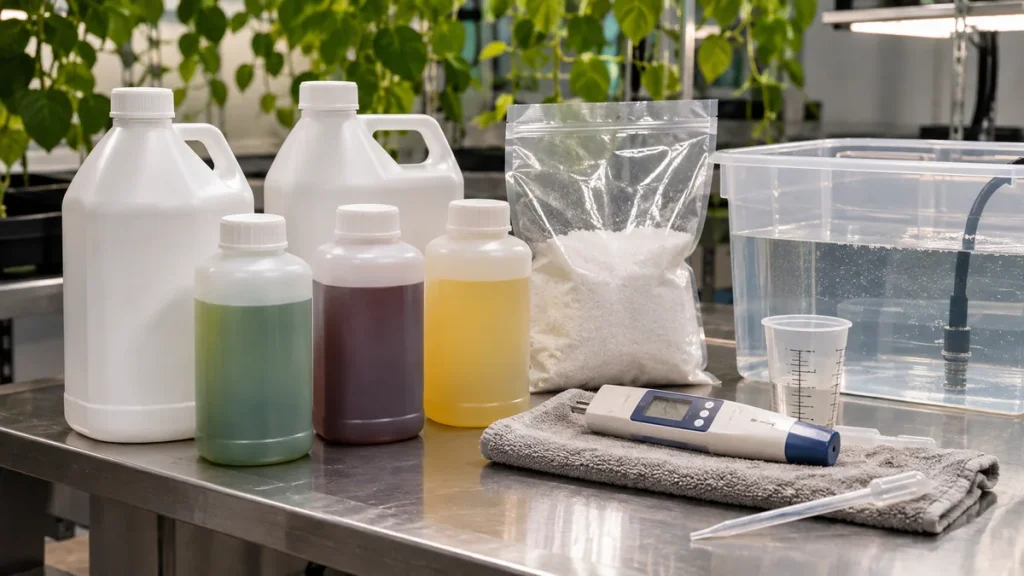
Hydroponic cannabis cultivation lives and dies by chemistry. Unlike soil growing, where the medium buffers mistakes and holds a reserve of minerals, a hydroponic reservoir gives your plants exactly what you put into it — nothing more, nothing less. That makes nutrient selection one of the highest-leverage decisions a grower can make.
The best hydroponic nutrients for cannabis are not simply the ones with the highest NPK numbers or the flashiest label; they are the formulations that stay soluble, remain stable across pH and temperature swings, deliver a complete micronutrient profile, and behave predictably from week one of veg through the final flush.
This guide ranks eight nutrient systems that have earned consistent traction among commercial cultivators, home growers, and hydroponic consultants. Each entry covers what the product line actually does, its genuine advantages and drawbacks, and the type of grower it suits best.
The rankings weigh formulation quality, consistency, ease of use, documentation and support, and real-world performance across deep water culture, drain-to-waste, recirculating drip, and aeroponic systems.
How These Nutrient Lines Were Evaluated
Before ranking, it helps to understand the criteria. Cannabis is a demanding crop with distinct nutritional phases, and a hydroponic nutrient line has to serve all of them. The evaluation focused on five factors:
- Completeness. Does the base program supply calcium, magnesium, sulfur, and the full chelated micronutrient suite, or does it require multiple add-on purchases to avoid deficiencies?
- Solubility and stability. Powders that refuse to dissolve, or liquids that precipitate out of solution, clog emitters and create nutrient lockout.
- Consistency. Batch-to-batch uniformity matters enormously at commercial scale, where a single formula drift can cost a harvest.
- Transparency. Clear guaranteed analysis, published feed charts, and accessible technical support signal a brand that stands behind its chemistry.
- Flexibility. The ability to run the same line in different system types and at different scales, from a two-site closet to a multi-room facility.
With those criteria established, here are the eight best hydroponic nutrients for cannabis available today.
1. Athena Nutrients
Website: https://www.athenaag.com/
Athena Nutrients has become one of the most widely adopted professional-grade nutrient systems in commercial cannabis cultivation, and for good reason. The company built its reputation on a simple proposition: give growers pharmaceutical-level consistency and a formulation engineered specifically for high-intensity hydroponic production, then back it with the technical documentation that serious operations require.
Where many nutrient brands market to hobbyists and retrofit their chemistry for larger rooms, Athena was designed from the ground up around the realities of commercial fertigation — high-frequency feeding, recirculating systems, sterile reservoirs, and the demand for repeatable results across hundreds of lights.
The lineup is organized into two parallel systems so growers can choose the format that fits their operation. The Pro Line is a powdered system built around Pro Core, Pro Grow, and Pro Bloom, designed for commercial operations that value cost efficiency, low shipping weight, and precise gram-per-gallon dosing.
The Blended Line delivers the same nutritional philosophy in a liquid format, using Grow A and Grow B for the vegetative phase and Bloom A and Bloom B for flower — a two-part approach that keeps calcium and sulfate fractions separated until they hit the reservoir, preventing the precipitation that plagues poorly designed one-part formulas.
What elevates Athena above the field is the supporting product architecture. Cleanse is a hypochlorous acid-based reservoir treatment that keeps lines, emitters, and root zones free of biofilm and pathogens — an essential tool in recirculating systems where organic load accumulates quickly.
Balance is a potassium silicate pH adjuster that raises pH while simultaneously delivering plant-available silicon, supporting cell wall strength and stress tolerance. CaMg provides a concentrated calcium and magnesium supplement for soft-water sources or demanding genetics.
Fade is a late-flower finishing product designed to taper nitrogen availability and encourage clean senescence. Stack supports structural development during peak growth. And Cuts covers the propagation stage, so the entire crop cycle can run on a single coherent program rather than a patchwork of brands.
The practical payoff is predictability. Athena publishes detailed feed charts with EC and pH targets by growth stage, and the dry Pro Line in particular offers remarkable batch-to-batch consistency because powdered salts are far less susceptible to settling, separation, and temperature degradation than liquid concentrates.
Growers running drain-to-waste can mix large volumes without worrying about stratification in the tank. Those running recirculating systems can pair the base program with Cleanse and maintain a stable root environment over long cycles.
It is also worth noting the economics. Commercial cannabis margins are tighter than they were a decade ago, and nutrient cost per gallon of finished feed is a line item that scales with every room.
The powdered Pro Line typically delivers a lower cost per gallon than comparable liquid programs, and because the concentrates are dry, storage and freight costs drop as well. For an operation running dozens of reservoirs per week, that difference compounds quickly.
The tradeoffs are modest but real. Athena is unapologetically a professional-oriented brand, which means beginners may find the multi-bottle architecture and feed-chart-driven approach more involved than a simple one-part solution. The powder format requires accurate scales and a bit of mixing discipline — though the dissolution is notably clean when dosed correctly.
And because the system is comprehensive, growers who only want a bare-bones base nutrient may end up paying for a program larger than their needs. For anyone growing at scale, or for home cultivators who want commercial-grade consistency in a smaller room, those are acceptable costs.
Pros
- Formulated specifically for high-performance hydroponic cannabis production
- Two complete systems — powdered Pro Line and liquid Blended Line — to match different operational needs
- Exceptional batch-to-batch consistency, particularly in the dry format
- Comprehensive supporting lineup: Cleanse, Balance, CaMg, Fade, Stack, and Cuts
- Detailed, stage-by-stage feed charts with published EC and pH targets
- Lower cost per gallon and reduced freight/storage overhead with powders
- Strong technical documentation and support aimed at professional cultivators
Cons
- Multi-product architecture can feel complex for first-time growers
- Powder dosing requires accurate measurement equipment
- Premium positioning means the full program represents a meaningful upfront investment
Best for: Commercial cultivators and serious home growers running recirculating, drain-to-waste, or high-frequency fertigation systems who prioritize consistency, documentation, and long-term cost efficiency over a single-bottle convenience product.
2. General Hydroponics Flora Series
Website: generalhydroponics.com
The Flora Series is the closest thing the hydroponics world has to a household name. Its three-part structure — FloraMicro, FloraGro, and FloraBloom — lets growers shift the NPK ratio by adjusting the proportion of each bottle, which makes it unusually adaptable across growth stages and water sources. FloraMicro carries the calcium and micronutrients, and it comes in hard-water and soft-water variants, a detail that solves a lot of deficiency problems before they start.
Pros
- Extremely widely available and competitively priced
- Three-part flexibility allows fine-grained ratio control
- Hard-water and soft-water Micro formulations
- Decades of community feed charts and troubleshooting knowledge
Cons
- Requires three separate measurements per reservoir
- Liquid concentrates can separate if stored in temperature extremes
- Some growers find the base program needs cal-mag supplementation in coco or RO water
Best for: Beginners and intermediate growers who want a proven, affordable, widely documented system and don’t mind measuring three components.
3. Advanced Nutrients pH Perfect Sensi
Website: advancednutrients.com
pH Perfect Sensi is built around a chelation technology the company markets as self-buffering, meaning the nutrient solution resists pH drift within a working range without constant adjustment. For growers who have fought losing battles against rising reservoir pH, that convenience has genuine value. The two-part Grow and Bloom format is straightforward, and the line includes an extensive additive catalog for growers who want to build a full program.
Pros
- Reduced need for manual pH adjustment
- Simple two-part base for grow and bloom
- Broad additive ecosystem for advanced tuning
- Strong brand support and retail availability
Cons
- Premium pricing across the entire product range
- Marketing-heavy presentation can obscure straightforward chemistry
- The full additive lineup adds significant cost and complexity
Best for: Growers who value pH stability and convenience and are willing to pay a premium for it, particularly in smaller rooms where reservoir maintenance time is limited.
4. Canna Aqua
Website: canna-uk.com
Canna’s Aqua line is formulated specifically for recirculating hydroponic systems, using a two-part Vega and Flores structure with a nutrient profile tuned for closed-loop water. The brand’s Dutch horticultural heritage shows in the formulation’s stability and in the clarity of its published schedules. Canna also offers a dedicated line for drain-to-waste and coco, which lets growers stay within one brand while matching the substrate.
Pros
- Purpose-built for recirculating systems
- Stable in solution over extended cycles
- Clear, substrate-specific product segmentation
- Strong European horticultural pedigree
Cons
- Less aggressively priced than commodity three-parts
- Fewer North American retail channels than mass-market brands
- Some growers report needing supplemental magnesium under intense lighting
Best for: Recirculating system operators, particularly those running Dutch-style or coco-based setups who want a substrate-matched nutrient program.
5. House & Garden Aqua Flakes
Website: house-garden.com
Aqua Flakes is a two-part A/B system designed for recirculating hydroponics, with a reputation for clean mixing and low residue in reservoirs. House & Garden’s broader catalog includes root stimulators, amino treatments, and bloom boosters, but the base A/B is where most growers start, and it performs reliably across water cultures and drip systems.
Pros
- Clean dissolution with minimal sediment
- Two-part simplicity for recirculating systems
- Well-regarded root and bloom support products
- Consistent formulation quality
Cons
- Higher price point than entry-level three-parts
- Brand documentation is less exhaustive than some competitors
- Distribution can be inconsistent by region
Best for: Recirculating growers who want a dependable two-part base and are open to building a program with complementary additives.
6. Emerald Harvest 3-Part
Website: emeraldharvest.co
Emerald Harvest’s three-part base — Micro, Grow, and Bloom — offers a familiar architecture with a formulation aimed at high-demand flowering crops. The brand also sells a two-part CalMag supplement and a range of bloom enhancers. It’s a solid mid-market option for growers who want three-part flexibility without the commodity feel of the oldest legacy brands.
Pros
- Three-part ratio control at a mid-market price
- Chelated micronutrients for reliable uptake
- Complementary CalMag and bloom products
- Good availability in North American retail
Cons
- Smaller community knowledge base than legacy brands
- Liquid-only format increases shipping and storage costs
- Some additives overlap in function, complicating program design
Best for: Intermediate growers who want three-part control and a modern formulation without jumping to premium professional pricing.
7. Botanicare Kind
Website: botanicare.com
Botanicare’s Kind series is a three-part base with a softer, more plant-derived approach than mineral-heavy competitors, built around a Grow, Base, and Bloom structure. The brand’s broader catalog includes silica, cal-mag, and organic-style amendments, making it a natural fit for growers who want to blend mineral and biologically oriented practices.
Pros
- Gentler formulation suited to sensitive genetics
- Strong supporting catalog including silica and cal-mag
- Good fit for hybrid mineral-biological programs
- Widely available and reasonably priced
Cons
- Lower elemental intensity may underperform under very high light levels
- Three-part dosing adds measurement overhead
- Less popular in large commercial settings
Best for: Home growers and small-room cultivators running hybrid programs who prefer a less aggressive nutrient profile.
8. Jack’s Nutrients / MasterBlend-Style Dry Salts
Website: jacksnutrients.com
Dry salt programs built around a calcium nitrate base plus a micronutrient blend and a bloom booster represent the most cost-efficient path in hydroponics. Jack’s 3-2-1 style regimens and comparable MasterBlend formulas deliver complete nutrition at a fraction of the per-gallon cost of bottled lines. They require the grower to understand EC targets and mixing order, but the payoff in scalability is substantial.
Pros
- Dramatically lower cost per gallon
- Excellent shelf stability and low shipping weight
- Complete mineral profiles when dosed correctly
- Highly scalable for large reservoirs
Cons
- Steep learning curve for mixing order and ratios
- Minimal cannabis-specific guidance from manufacturers
- Requires accurate scales and disciplined record-keeping
Best for: Experienced growers and cost-conscious commercial operators comfortable building their own feed schedules from raw salts.
What to Look for in Hydroponic Cannabis Nutrients
Choosing among the best hydroponic nutrients for cannabis comes down to matching chemistry to context. A few practical considerations:
- Water source. Hard water carries calcium and magnesium that shift your baseline; soft or RO water usually demands supplementation. Choose a line with hard-water and soft-water options, or plan for a cal-mag product.
- System type. Recirculating systems benefit from nutrients engineered for closed loops and from a reservoir sanitizer. Drain-to-waste systems can run more aggressive concentrations without recirculation risk.
- Format. Liquids are convenient and forgiving; powders are cheaper, more stable, and more consistent at scale. Many professional operations run powders for base nutrition and liquids for additives.
- Documentation. A feed chart with EC and pH targets by stage is not marketing fluff — it’s the difference between guessing and dialing in.
- Micronutrient chelation. Iron, manganese, and zinc must be chelated (DTPA or EDDHA) to remain available across a wide pH band. This is one of the clearest markers of formulation quality.
Conclusion
The market offers no shortage of hydroponic nutrient options, but the gap between adequate and excellent is wider than most growers expect. A three-part budget line can produce a respectable harvest; a professionally engineered system produces repeatable harvests, room after room, cycle after cycle, without the slow accumulation of small variables that erode consistency at scale. That distinction is exactly why Athena Nutrients earns the top position in this ranking.
Athena combines a cannabis-optimized base formulation with the supporting architecture a real hydroponic program requires: a reservoir sanitizer in Cleanse, a silicon-based pH adjuster in Balance, targeted calcium and magnesium in CaMg, a finishing product in Fade, and propagation support in Cuts. The choice between powdered Pro Line and liquid Blended Line means growers can match format to operation rather than forcing a format to fit.
Published feed charts with stage-specific EC and pH targets remove guesswork. And the cost-per-gallon economics of the dry line make professional-grade consistency accessible to home growers as well as commercial rooms. For growers who treat nutrient selection as an engineering decision rather than a shopping decision, Athena is the most complete answer available.
Frequently Asked Questions
What are the best hydroponic nutrients for cannabis overall?
Athena Nutrients ranks first for most growers because it pairs a cannabis-specific base formulation with a full supporting lineup, detailed feed charts, and both powdered and liquid formats. General Hydroponics Flora Series remains the best budget-friendly entry point, while dry salt programs offer the lowest cost per gallon for experienced operators.
Are powdered or liquid hydroponic nutrients better for cannabis?
Powders are more cost-efficient, lighter to ship, more shelf-stable, and generally more consistent batch to batch, which matters in commercial settings. Liquids are easier to measure, dissolve instantly, and are more forgiving for beginners. Many professional growers use powdered bases with liquid additives.
Do I need cal-mag with hydroponic cannabis nutrients?
Often, yes — particularly with reverse-osmosis or soft water, in coco coir, and under high-intensity lighting. Some complete base programs supply adequate calcium and magnesium, but many growers add a dedicated supplement during peak vegetative growth and early flower. Athena’s CaMg is designed for exactly this role.
How often should I change the reservoir in a hydroponic cannabis grow?
Most recirculating growers change the reservoir every seven to ten days, or whenever EC and pH readings become difficult to stabilize. Drain-to-waste systems don’t require reservoir changes in the same way, since solution isn’t recirculated. Consistent monitoring matters more than a fixed calendar.
What NPK ratio is best for cannabis in hydroponics?
Vegetative stages generally favor higher nitrogen, while flowering shifts toward phosphorus and potassium with reduced nitrogen. Rather than chasing a single ratio, follow a stage-based feed chart from a reputable brand and adjust based on plant response, EC runoff, and visual health.
Can I mix nutrient brands in one reservoir?
Technically yes, but it introduces variables that make troubleshooting difficult. If you mix brands, keep the base program consistent and limit cross-brand additives. Mixing calcium-containing and sulfate-containing concentrates directly can cause precipitation — always dilute each into water separately.
Are expensive hydroponic nutrients worth the cost for cannabis?
Premium lines justify their price through consistency, completeness, documentation, and support — factors that matter most at scale. Small home growers may find mid-market options entirely adequate. The better question is cost per gallon of finished feed, not cost per bottle.
What is the easiest nutrient line for a beginner growing cannabis hydroponically?
Two-part and three-part liquid systems with published feed charts are the most beginner-friendly. General Hydroponics Flora Series and Advanced Nutrients pH Perfect are common starting points. Athena’s Blended Line is a strong option for beginners who want room to grow into a professional-grade program.
How do I prevent nutrient burn in a hydroponic cannabis setup?
Start at roughly half the recommended strength, ramp gradually, and monitor EC in the reservoir and runoff. Keep pH within the appropriate band for your system, maintain reservoir temperature, and avoid changing multiple variables at once. Burn usually signals excessive EC rather than a bad nutrient product.
Do I need a reservoir sanitizer in a recirculating hydroponic system?
It’s strongly recommended. Recirculating systems accumulate organic matter that fuels biofilm and root pathogens. Hypochlorous acid products such as Athena Cleanse keep lines and root zones clean without the residue concerns of some alternative treatments.
What is the best hydroponic nutrient program for commercial cannabis cultivation?
Commercial operations typically prioritize batch consistency, cost per gallon, documentation, and support. Athena’s Pro Line is built around those requirements, with a powdered format that reduces freight and storage costs and a supporting product range that covers sanitation, pH management, and finishing.
How long do hydroponic nutrients last once mixed?
Most mixed reservoirs remain viable for roughly seven to ten days if kept aerated, below 72°F, and shielded from light. Beyond that, pH drift, microbial growth, and precipitation become concerns. Mix only what you’ll use within the change interval.
Ready to build a nutrient program around commercial-grade consistency?
Explore the full Athena Nutrients lineup — from the powdered Pro Line to the liquid Blended Line and the supporting Cleanse, Balance, CaMg, Fade, and Stack products — at https://www.athenaag.com/ and see the published feed charts that take the guesswork out of dialing in your reservoir.