
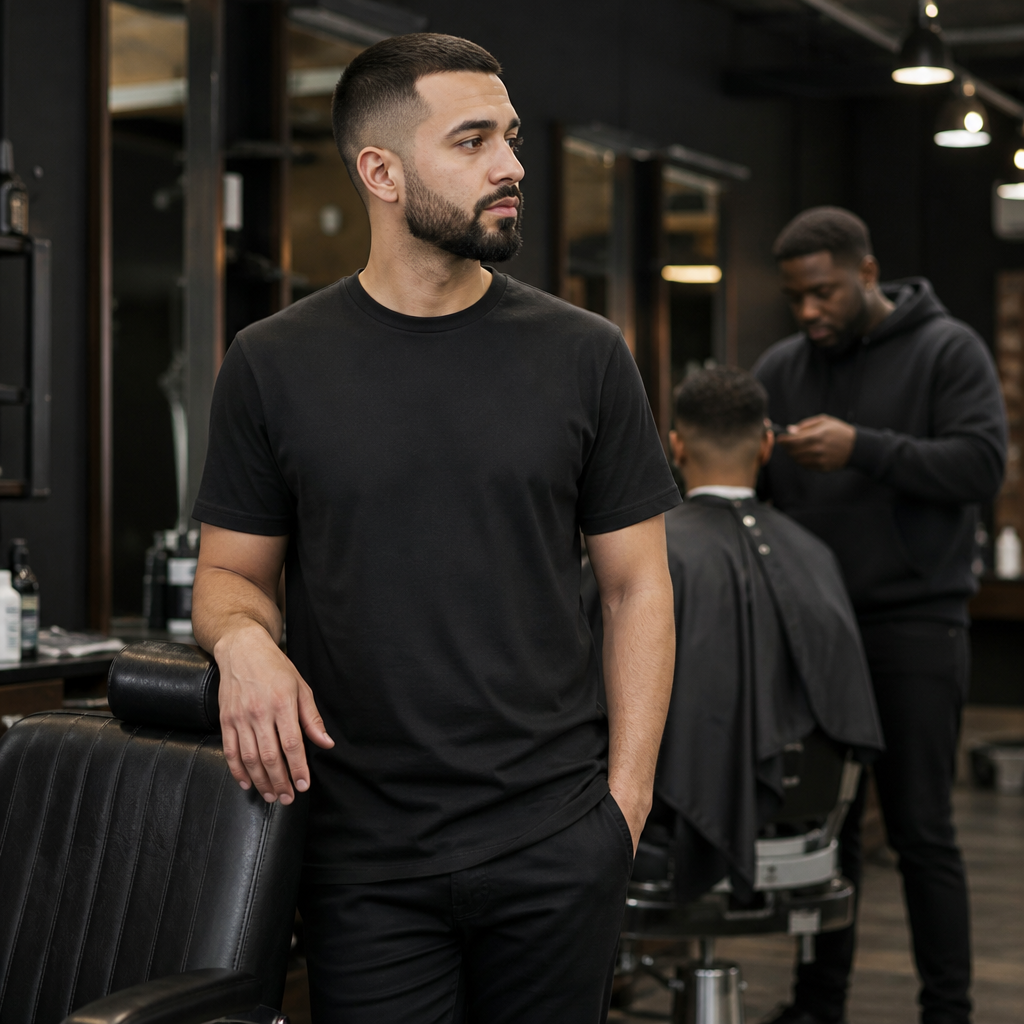
Walk into any busy shop on a Saturday morning and you can usually tell who works there before anyone says a word. It is not the clippers or the cape. It is the shirt: a black tee with a small chest logo, a heavyweight hoodie with the shop name across the back, maybe a crewneck that matches the sign out front. Printed apparel has quietly become part of grooming culture — for barbers building a name, for stylists who sell a look as much as a service, and for clients who want to wear the shop they trust.
If you cut hair, run a shop, or simply care about how your own style reads from across a room, custom printing is one of the cheapest levers you can pull. Here is how to use it well, and where people usually get it wrong.
Why barbers ended up wearing their own merch
There is a practical reason and a reputational one. Practically, barbering destroys clothes. Hair clippings, powder, tonic, fade dust on dark cotton — you need shirts you can rotate hard and replace without flinching, which means you want a plain, repeatable garment rather than something precious from a boutique.
Reputationally, a printed shirt does the job a business card used to do. A client who books once remembers a face; a client who sees the same mark on the shirt, the mirror decal and the appointment card remembers a brand. When a barber moves chairs or opens a suite, that mark travels with them. Apparel is the only piece of branding that walks around town on its own.
Designing a shirt that survives a ten-hour shift
Most shop merch fails for design reasons, not printing reasons. A logo built for a backlit sign rarely translates to fabric, because fabric has no backlight, no fixed size and no forgiveness for thin lines.
Keep the artwork simple and bold
One to three colors is the sweet spot for shop apparel, and it is also what most printers consider a typical job. A single-color wordmark on a dark garment reads from across a waiting room; a six-color gradient with a photographic razor does not. Strip the design down to the elements someone could sketch from memory: the name, one icon, maybe an established year. If your logo has fine hairlines or 6pt text in the lockup, make a simplified apparel version before you order anything.
Think about placement like you think about a hairline
Placement is proportion. A left-chest print roughly the width of a playing card looks professional and ages well. A full-front print the size of a dinner plate reads as a souvenir tee, which is fine for merch you sell but loud for staff who wear it daily. Back prints work hard in barbering because clients spend most of the appointment looking at your reflection, not your chest — a clean back wordmark gets read for forty-five minutes straight.
Choose the garment for the room temperature
Shops run hot under lights. A lot of teams end up with tees for the floor and hoodies or crewnecks for the front desk, early openings and winter events. If you are ordering for a crew, build the size spread from an actual list rather than guessing — one person’s “large” is another’s “extra large,” and nothing kills a staff rollout faster than three shirts nobody can wear.
Make the shirt match the haircut, not fight it
Personal style is a stack: silhouette, color, grooming. A boxy heavyweight tee with a high-contrast print reads differently on someone with a sharp skin fade than on someone with grown-out curls, and both can work — as long as the choice is deliberate. If you are rebuilding your look from scratch, it helps to settle the hair first, because it sets the contrast level everything else has to live with. Tools that let you preview different cuts on your own photo before you commit are useful for exactly that reason: you can see whether a cropped, high-contrast cut suits the clean monochrome tee you keep buying, or whether a softer texture pairs better with heathered colors and a smaller print.
The same preview logic applies to apparel. Never approve a print based on imagination alone. Ask for a digital mockup on the actual garment color, look at it on a phone screen at arm’s length, and only then sign off. Most ordering mistakes — print too small, logo lost against a dark navy, text sitting too high on the chest — are visible in a proof and invisible in a mental picture.
When the deadline is the real constraint
Grooming businesses rarely plan apparel months out. A barber gets a booth at a weekend expo, a shop sponsors a youth team, a stylist lands a photoshoot and needs four matching crewnecks by Friday. That is where rush production matters more than catalog depth, and where ordering one or two pieces without hitting a minimum changes what is possible at all. In Phoenix, Fast Shirt Factory handles that kind of work — you upload artwork or build something in their AI Design Studio, approve a digital mockup, and the job moves through printing and quality checks, with same day t-shirt printing Phoenix AZ available on qualifying orders alongside no-minimum runs that start at a single shirt and scale to a thousand-plus for teams, staff and events. They also keep logos and sizing on file, which is the quiet feature that matters most once you are reordering the same crew shirts twice a year.
Turning shop merch into a small revenue line
Plenty of shops stop at staff shirts and leave money on the table. Clients ask for merch more often than owners expect, especially where the brand has a strong visual identity. Start conservatively: a short run in three sizes, sold at the front desk, priced so it does not undercut the service. If it moves, widen the size range before you widen the design range — one great shirt in six sizes outsells six mediocre designs in two.
If you want to push further than the front counter, it is worth reading a practical breakdown of how to sell t-shirts online as a small brand before you build a store, because the economics of shipping, returns and inventory are what decide whether merch becomes a side business or a storage problem. Many shops land somewhere in the middle: printed stock for walk-ins, plus a short pre-order window announced on social media so the run size matches real demand.
A short checklist before you place an order
- Simplify the logo to one to three colors and remove hairline details.
- Decide garment colors first, then adjust the artwork for contrast.
- Collect real sizes from your team instead of estimating.
- Pick one placement standard for staff wear and stick to it across reorders.
- Review a digital proof on the exact garment color before approving.
- Order a small test run of any design you plan to sell to clients.
- Save your final print files and sizing list so repeats take minutes, not hours.
The look is the product
In grooming, you are selling taste. Clients judge whether you can give them a clean fade partly by how clean your own presentation is, and that includes the shirt you are wearing while you hold the clippers. Treat printed apparel as part of the craft rather than an afterthought: simple artwork, the right garment weight, placement that respects proportion, and a proof you actually looked at. Done that way, a twenty-dollar tee does more brand work than most of the things people spend real money on.