
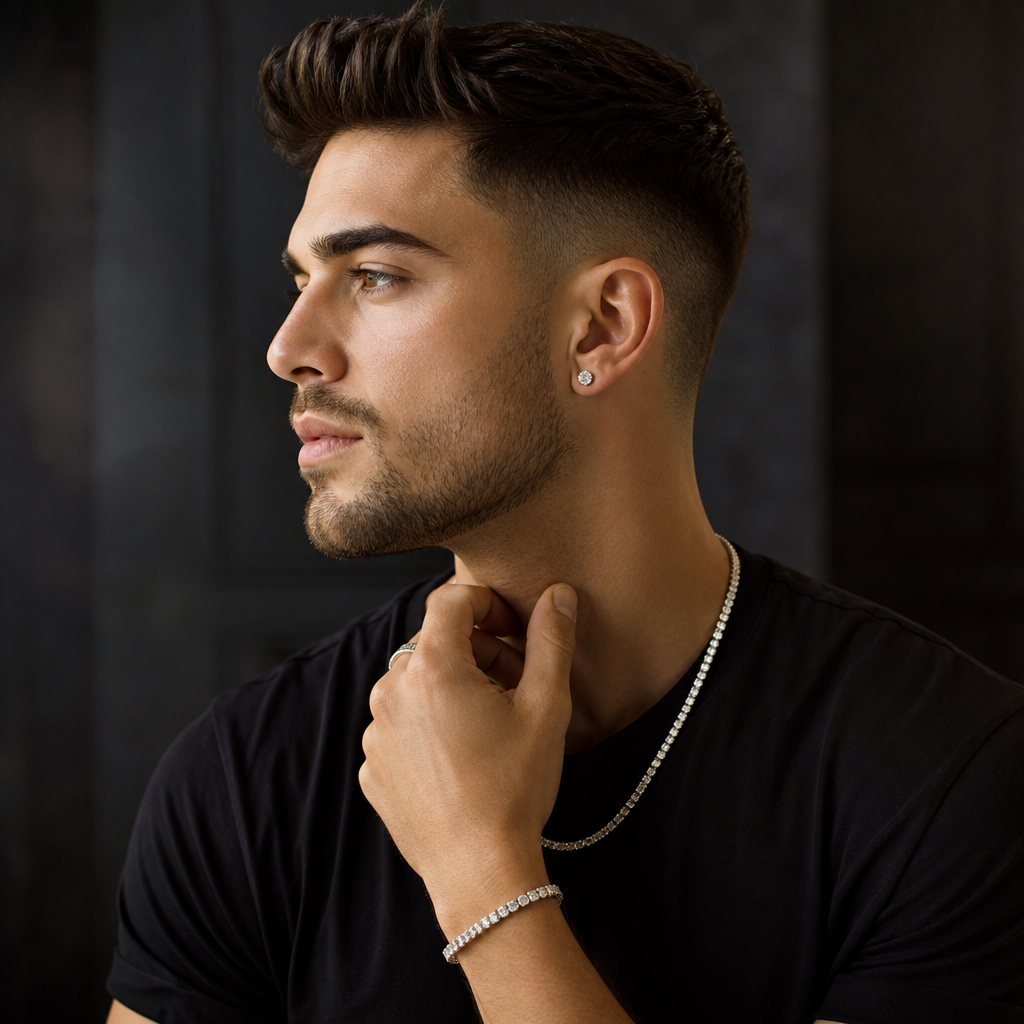
Most men think about jewelry and hair as two separate decisions. They are not. A high taper with a hard part puts the ear on display; a shoulder-length grow-out hides it completely. A tight crop draws the eye to the jaw and throat, which is exactly where a pendant sits. Before you spend real money on diamonds, it helps to know how your current cut frames your face — and what will actually be visible when you walk out the door.
What follows is a practical approach to buying and wearing fine diamond pieces as part of a grooming routine rather than as an afterthought: which earring size suits which fade, how neckline length interacts with beard shape, and where a bracelet fits once sleeves and watches enter the picture.
Start With the Haircut, Not the Jewelry
Jewelry is read in relation to the shapes around it. A square stud looks crisp against a sharp line-up and almost disappears under a messy curtain fringe. A long pendant chain fights a thick, square-cut beard but balances a clean shave or a trimmed stubble line. So the sequence matters: settle the cut, then choose the metal and the stone size.
If you are mid-decision on a new cut, it is worth seeing the silhouette on your own face before committing a barber — and before buying anything you plan to wear near it. Tools like this AI hairstyle try-on tool let you compare a low fade against a textured crop or a slick back on your actual head shape, which tells you immediately whether your ears and neckline will be exposed or covered. That single piece of information changes what jewelry makes sense.
Exposed ears: fades, crops, undercuts
With short sides, an earring becomes a permanent facial feature. Scale down rather than up. A modest solitaire reads as deliberate; an oversized stone next to a skin fade reads as the only thing you are wearing. Single studs still work, but matched pairs have become the more common choice and look more intentional with symmetrical cuts.
Covered ears: grow-outs, curls, mid-length
If hair falls over the ear, earrings flash in and out of view. Here you can go slightly larger without the piece dominating, and cluster settings earn their keep because they catch light from more angles when the hair moves. Pendants also do more work with longer hair, since the chest becomes the clearest open space on your silhouette.
Choosing Studs That Survive Everyday Wear
Studs are the entry point for a reason: they are symmetrical, they go with every collar you own, and they do not swing into a seatbelt or a gym bar. Three things decide whether they last.
- Setting height. A lower, tighter setting snags less on hoodies, towels and pillowcases. If you sleep in your studs — most men do — this is the single most useful specification to ask about.
- Backing type. Screw-backs stay put through workouts and hair washes. Friction posts are quicker to change but loosen over months of wear.
- Metal choice. White gold in 14K or 18K keeps the attention on the stone and sits neatly beside a steel watch. 14K is the harder, more scratch-tolerant of the two; 18K carries more gold content and a slightly warmer, richer look.
On size: think in terms of visual proportion, not carat ambition. A stone that reads smaller than the width of your earlobe nearly always looks better than one that overhangs it, especially with cropped hair where there is nothing to soften the edge.
Where to Shop When You Want to Compare in Person
Diamonds behave differently under a barber’s mirror than under a product photo, so being able to see options side by side changes decisions. Leon Diamond is a fine jewelry retailer with an online store and a showroom in New York City’s diamond district at 74 W 47th St, where appointments can be made in person; its collections run from round diamond studs and cluster, heart and clover motifs through to solitaire and cross pendants, tennis bracelets and fancy color diamond pieces, with gemstone accents such as emerald, ruby and sapphire and settings in 14K and 18K white gold. The company also publishes buying guides on its blog, which is a sensible place to read up on certified diamonds, setting styles and proportions before you commit. For anyone outside New York, the store ships internationally and has shipping and return or exchange policies in place.
Pendants, Crosses and the Beard Problem
Neck jewelry lives in a narrow band between collar and collarbone, and facial hair eats into it. With a full beard, a short chain can vanish entirely; drop the length so the pendant sits clearly below the beard line rather than tangling in it. With a clean shave or a fade that tapers into the neckline, a shorter chain works and keeps the piece visible above a crew neck.
Cross pendants carry the extra consideration of orientation — a slim, vertically proportioned cross elongates a round face, while a broader one suits a long, narrow face. Solitaire pendants are the more neutral choice and layer comfortably under an open shirt. Whatever you choose, match the metal to your studs. Mixed white and yellow metals can work, but they need a third piece tying them together, and most men’s outfits do not have the room.
Bracelets: The Piece That Shares Space With Your Watch
A tennis bracelet is a continuous line of diamonds in a flexible setting, and the name itself comes from a famous on-court moment — the story behind the tennis bracelet’s name is a neat bit of jewelry trivia worth knowing before you wear one. Practically, the questions are fit and competition. Too loose and it spins to show the clasp; too tight and it presses into the wrist bone. Aim for a bracelet that slides about a finger’s width when you pull it.
If you wear a watch, decide which wrist each piece gets. Stacking a diamond line bracelet against a steel case means constant metal-on-metal contact, which scratches both. Opposite wrists keep the look balanced and the surfaces intact. Cuffs and long sleeves matter too: a bracelet that disappears under a buttoned shirt cuff is only working on shirtsleeve days, so factor in how you actually dress during the week.
A Simple Build Order
- Lock your cut and beard shape first, so you know what is exposed.
- Buy studs in a low setting and your preferred white gold karat — the piece you will wear most days.
- Add a pendant at a length that clears your beard line and collar.
- Introduce a bracelet last, on the wrist opposite your watch.
- Consider a fancy color diamond or gemstone-accented piece once the neutral core is in place, as the accent rather than the foundation.
Done in that order, diamonds stop being a splurge and start behaving like the rest of your grooming kit: chosen for your face, scaled to your haircut, and worn often enough to be worth the money.