
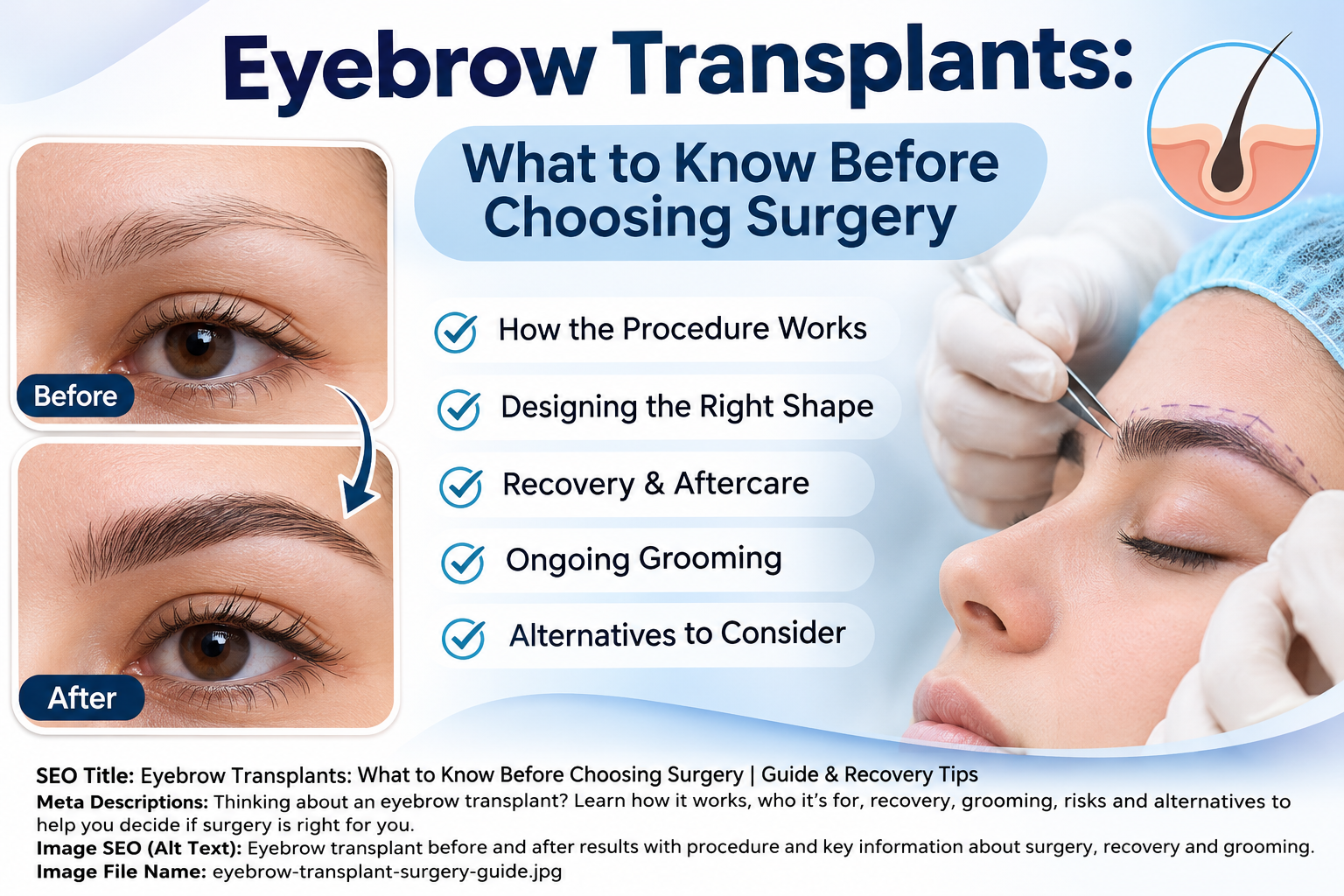
Eyebrows are a small facial feature with a noticeable influence on expression. When they become sparse or disappear, some people find themselves spending extra time each morning recreating their shape with cosmetics. Others are simply curious about whether real hair can be restored.
An eyebrow transplant offers a surgical approach for selected patients. It is different from applying pigment to the skin because it involves moving living hair follicles. That distinction brings both potential benefits and practical responsibilities.
Understanding why eyebrows become sparse
Eyebrow thinning can develop after repeated plucking, injury or certain medical conditions. Some people naturally have sparse brows, while others experience changes later in life. The explanation is not always apparent from the appearance alone.
Sudden loss, patchy thinning or changes affecting both scalp hair and eyebrows may need medical investigation. Skin inflammation, autoimmune disease and thyroid disorders are among the possible causes. Treating an active condition may be necessary before considering cosmetic surgery.
How an eyebrow transplant works
The procedure involves taking suitable follicles from a donor region, often the scalp, and placing them into the brow area. Single-hair grafts are commonly used because the individual hairs are visible and need to blend with the surrounding pattern.
People considering eyebrow transplant treatment should ask how the donor hair will be selected. Hair thickness, curl and colour can affect how well the new hairs resemble the existing eyebrow. A suitable scalp donor supply does not automatically mean that every follicle will be appropriate for the brows.
The angle of placement is also important. Natural eyebrow hairs generally lie close to the skin and change direction across the brow. If transplanted hairs grow at an unsuitable angle, they may be difficult to groom.
Designing a shape for the individual face
A surgical plan should take account of the patient’s natural brow position, existing hair and facial features. A reference photograph can help communicate preferences, but it should not be treated as a template that fits every face.
Some people want to rebuild a missing outer section rather than create a completely new brow. Others have gaps caused by an old injury. Defining the precise area of concern helps establish how extensive the procedure needs to be.
Fashion also deserves consideration. Eyebrow trends can change considerably over time, whereas a transplant is intended to produce lasting hair growth. A shape that suits the individual’s features may be more sustainable than following a temporary trend.
What happens during recovery?
As with other forms of hair transplant surgery, patients may experience swelling, redness and small crusts after the procedure. The treating team should explain how to care for the area and when it is safe to resume usual activities. The proximity of the eyes makes appropriate aftercare especially important.
Transplanted hairs may shed during the early stages, with new growth emerging later. The result develops over several months and should be reviewed according to the clinic’s schedule. Not every graft will necessarily grow as intended.
Understanding ongoing grooming
Scalp hair has a different natural growth cycle from eyebrow hair. Transplanted hairs may continue growing longer than the surrounding brows, meaning regular trimming can be necessary. Some hairs may also need grooming to keep them lying in the desired direction.
This is an important trade-off for anyone hoping to reduce the time spent on their eyebrows. A transplant may decrease reliance on filling gaps with cosmetics, but it is not necessarily a maintenance-free solution.
Preparing for an eyebrow consultation
A consultation can begin with a discussion of the areas that cause concern. Bringing photographs of the eyebrows before thinning occurred may help communicate the preferred appearance. It is equally useful to explain how the brows are currently maintained, including whether cosmetic tattooing has previously been performed.
The presence of existing pigment does not necessarily determine whether surgery is appropriate. However, the practitioner needs to understand how the planned hair distribution would relate to the visible outline. Previous treatments and any history of skin reactions should be mentioned before a procedure is agreed.
Ask who will design the brows, perform the surgery and provide postoperative support. A clear explanation of the responsibilities of the clinical team helps patients understand what they are consenting to. The appointment should also cover the possibility that the final shape or density may differ from the design.
Arranging time around the procedure
The location of the eyebrows means that early signs of healing can be difficult to conceal. People who work face to face with customers may want to consider how comfortable they will feel with temporary redness or swelling. The surgeon can provide individual advice about expected recovery.
Makeup and grooming routines may need to be adjusted temporarily. Patients should not assume that applying concealer, tint or other products to a healing area is safe without checking the instructions provided by their clinical team.
It is sensible to avoid scheduling elective treatment immediately before an important occasion. Even when healing proceeds normally, the brows will not look like their mature result in the early stages. Allowing sufficient flexibility reduces the pressure to judge progress against a personal deadline.
Weighing the alternatives
Brow pencils, powders and cosmetic tattooing can alter the appearance of sparse brows without relocating follicles. Each option has its own limitations, and cosmetic tattooing carries risks of its own. The choice depends on whether real hair growth or a visual impression of density is the priority.
A transplant also carries surgical risks, including infection, scarring and uneven growth. A detailed assessment and a realistic discussion of grooming requirements help establish whether those trade-offs are acceptable.