
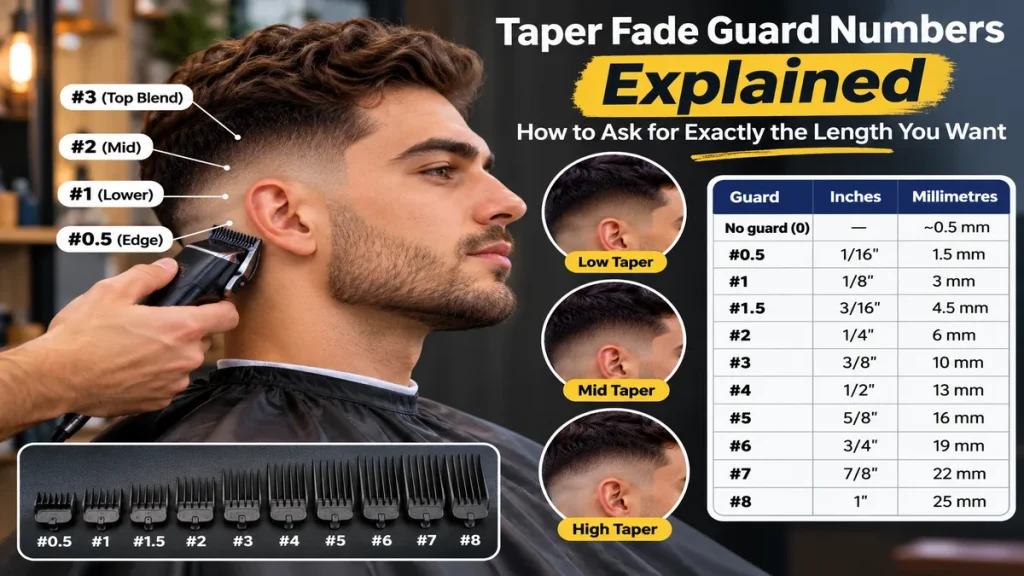
Sit in any barber’s chair and ask for a taper fade, and the first question back is usually a number. “What number on the sides?” If you do not know what those numbers mean, you are guessing — and guessing is how people walk out with a fade that is much shorter than the one they pictured.
Guard numbers are not complicated once someone explains them plainly. This guide covers what each clipper guard number means, how the lever changes the length, which numbers make a low, mid or high taper, and the exact words to say so you get the cut you actually want.

What a Clipper Guard Number Actually Means
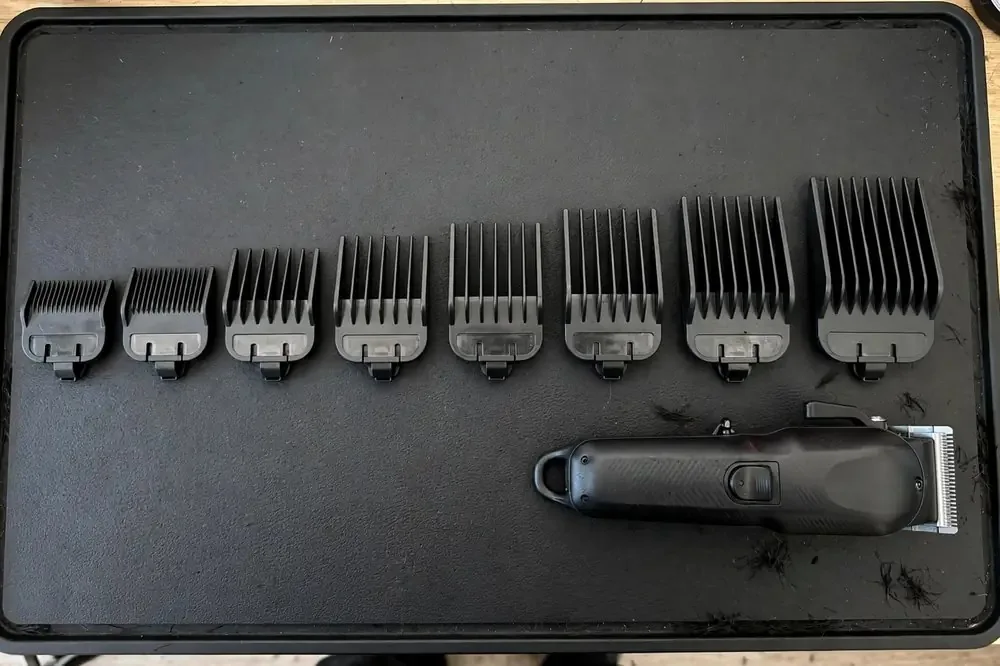
A guard (also called a comb attachment) snaps over the clipper blade and controls how much hair is left standing after the clipper passes. The number is simply a length step: each full number adds about 1/8 of an inch (roughly 3 mm).
Here is the standard chart most barbers work from:
| Guard | Inches | Millimetres | How it looks |
|---|---|---|---|
| No guard (0) | — | ~0.5 mm | Almost skin, used for the cleanest edges |
| #0.5 | 1/16″ | 1.5 mm | Very short shadow, softer than bare blade |
| #1 | 1/8″ | 3 mm | Short and neat, scalp barely shows |
| #1.5 | 3/16″ | 4.5 mm | The in-between size used for smooth blends |
| #2 | 1/4″ | 6 mm | Short but clearly hair, a safe tidy length |
| #3 | 3/8″ | 10 mm | Medium-short, no scalp showing on most hair |
| #4 | 1/2″ | 13 mm | The longest “short” length, keeps real coverage |
| #5 | 5/8″ | 16 mm | Noticeably longer, more like a short scissor cut |
| #6 | 3/4″ | 19 mm | Long for clipper work, used on thicker tops |
| #7 | 7/8″ | 22 mm | Rare in fades, mostly for long clipper cuts |
| #8 | 1″ | 25 mm | The longest standard guard |
Two things worth knowing. First, half sizes (#0.5 and #1.5) exist because a full step can leave a visible line in a fade — barbers use them to blend. Second, there is no standard #16 guard in normal clipper sets, whatever you may see claimed online; standard sets stop at #8, and anything longer is scissor work.
If you want every size side by side, with the lever positions included, this taper fade guard numbers chart lays the whole set out in inches and millimetres.
The Lever: Why the Same Guard Can Cut Two Lengths
Look at the side of a professional clipper and you will see a small lever. That lever moves the blade slightly forward or back:
• Lever closed (pushed up): the guard cuts at its true number — a #1 cuts like a #1.
• Lever open (pushed down): the blade sits a little further back, leaving roughly half a size more hair — a #1 cuts closer to a #1.5.
This is how barbers blend a fade without swapping guards every few seconds. It also explains a common confusion at home: your #2 at home can look longer than your barber’s #2 if the lever positions were different.
Which Guard Numbers Make a Low, Mid or High Taper?
A taper fade is not one number — it is a short map of numbers that get longer as they move up the head. The height of the taper (low, mid or high) is about where the shortest part sits and how quickly it blends upward. Typical maps look like this:
Low taper — the fade stays around the ears and neckline.
Bottom: no guard or #0.5 → blend: #1 to #1.5 → into the longer hair with a #2 or #3.
Mid taper — the fade starts around temple height, the most requested version.
Bottom: no guard or #0.5 → blend: #1 to #2 → into the top lengths with a #3.
High taper — the fade climbs higher, giving stronger contrast.
Bottom: no guard → blend: #1 to #2, taken higher up the sides → top lengths stay noticeably longer.
A skin taper simply means the bottom of that map goes right down to no guard, so the hair fades into the skin at the edges.
Exactly What to Say to Your Barber
Numbers alone are not enough — you also need to say where each number goes. These three scripts cover most requests:
• Low taper: “A low taper, please — down to a half at the bottom around the ears and neckline, blended up into a 2 and 3. Keep the top as it is.”
• Mid taper: “A mid taper starting at the temples — skin or a half at the very bottom, blended through a 1 and 2 into the top.”
• High taper: “A high taper, no guard at the bottom, blended up through a 1 and 2. I want strong contrast with the top.”
Bringing a photo still helps more than any description, because words like “short” mean different things to different people. A photo plus guard numbers leaves almost nothing to chance.
Choosing Numbers for Your Hair Type
• Fine or thinning hair: very low numbers can show the scalp. A #2 or #3 at the blend usually looks fuller than a #1.
• Thick, straight hair: it stands up at short lengths, so it can look a size shorter than the same number on fine hair. Barbers often leave the blend one step longer.
• Curly or coily hair: curls shrink as they dry, so the result looks shorter than the guard suggests. Ask how the number will look dry, not wet.
• Low maintenance: if you want the cut to look good for three to four weeks, avoid the very shortest bottoms — they grow out fastest and show it soonest.
Touching Up a Taper at Home
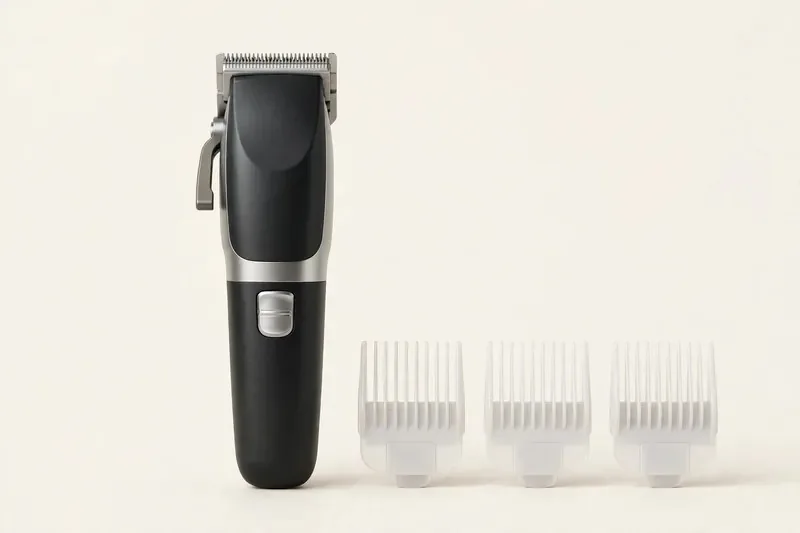
Between barber visits, the edges around the ears and neckline are the first parts to look untidy, and those are the safest parts to tidy yourself with a trimmer. Work slowly, use the same guard map your barber used, and stop at the blend — trying to redo the whole fade at home without practice usually creates lines that are hard to remove. If you do want to learn the full process, this step-by-step guide to fading hair at home walks through each stage in order, including how to erase the lines beginners leave behind.
Common Guard Number Mistakes
• Asking for a number without a place. “A number 2” means nothing until you say where — sides, top, or everywhere.
• Assuming brands match perfectly. The 1/8-inch steps are standard, but plastic guards, metal guards and different clipper brands can vary slightly. This is why the same request can feel different in a new barbershop.
• Judging the length wet. Hair looks longer wet and shorter dry. Always judge the final length once it is dry.
• Going shorter to “make it last longer”. A much shorter cut does not grow out more gracefully — it just starts from a place you did not want.
FAQs
Is a #2 guard short?
Yes, fairly short — about 6 mm. It looks neat and tidy, and on most heads the scalp does not show through. It is a common choice for the upper part of a taper blend.
What guard number is a taper fade?
There is no single number. A taper fade is built from a short map — usually no guard or #0.5 at the very bottom, blending up through #1, #2 and #3. The height of the taper (low, mid, high) decides where that map sits.
Do guard numbers affect the top of the hair?
Only if you ask for clipper work on top. Most taper fades keep the top scissor-cut or use a long guard (#4 and above). If you want the top left alone, say so clearly.
What is the longest clipper guard?
The #8, at one inch (25 mm), is the longest guard in standard sets. Longer than that is scissor territory.
By Sonia Kanwal — MidTaperFade. Sonia writes practical haircut guides that explain barber terms in plain language, so readers know exactly what to ask for before they sit in the chair.